
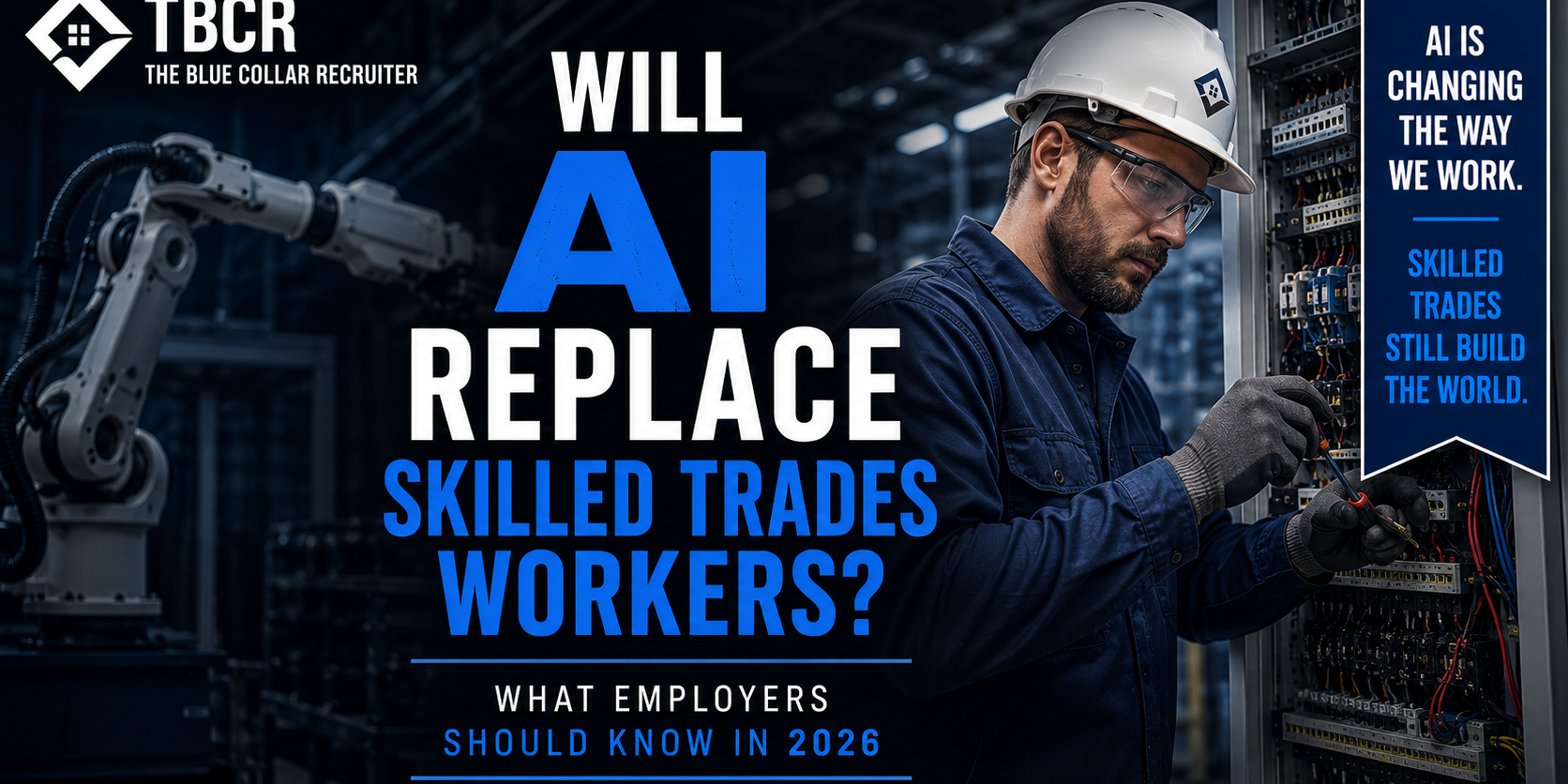
Will AI Replace Skilled Trades Workers? What Employers Should Know in 2027
Related Reading: How AI Is Changing the Trades in 2026 | Blue Collar Labor Shortage 2026
For more context, read why your job is safer than you think.
Short answer: no. Not for the trades that involve working with your hands in a physical space that changes every job.
The longer answer matters more if you employ tradespeople, because AI is going to change what you hire for even though it is not going to replace who you hire.
What the Federal Data Actually Shows
The Bureau of Labor Statistics does not project decline in the skilled trades. It projects the opposite through 2034.
- Wind turbine service technicians: 50% growth, the fastest of any occupation in the country
- Solar photovoltaic installers: 42% growth
- Industrial machinery mechanics: 16% growth
- Electricians: 9% growth
- HVAC mechanics and installers: 8% growth, roughly 40,100 openings a year
- Electrical power-line installers: 7% growth
Those are the same years everyone expects AI to reshape white-collar work. The trades are projected to grow through it.
Why the Trades Resist Automation
Automation works best where the task repeats in a controlled environment. A factory line is controlled. A crawlspace is not.
A service tech walks into a building nobody has documented properly, diagnoses a system installed by someone who cut corners eleven years ago, and works around whatever is physically in the way. Every call is a new problem in a new space.
That combination of physical dexterity, live diagnosis, and judgment under unpredictable conditions is exactly what current AI does not do.
There is also a demand story running underneath. AI needs data centers. Data centers need electricians, pipefitters, and HVAC crews at a scale the grid has not seen. The technology that is supposed to threaten the trades is currently one of the biggest drivers of demand for them.
What AI Does Change for Employers
The work in the field stays human. The work around it does not.
Diagnostics get faster. Connected equipment increasingly flags its own faults. Your tech arrives knowing more than they used to, which shortens calls and raises the number of jobs per truck per day.
Scheduling and dispatch get sharper. Route and load optimization squeezes real margin out of the same headcount.
The skill mix shifts. The tech who can read a diagnostic dashboard, work a tablet, and document a job cleanly becomes more valuable than the one who only turns wrenches. That is a training question, not a replacement question.
Your back office thins before your field crew does. If you are planning for AI displacement, look at scheduling, intake, and paperwork first. That is where it lands.
The Real Risk Is Not AI
The threat to your capacity over the next decade is not a robot. It is the retirement curve.
Experienced tradespeople are aging out faster than apprentices are coming in. BLS counts tens of thousands of annual openings in HVAC and electrical alone, and most of those come from workers leaving the field rather than new positions being created.
Employers who spend the next two years worrying about automation, while their best techs retire and their apprenticeship pipeline stays empty, will lose capacity. Not to software. To math.
What to Do About It
Build the apprenticeship pipeline now, before the retirements land. Train your existing techs on the diagnostic tools instead of replacing them. Automate the office work, not the field work. And stop treating AI as a reason to slow down hiring, because the data says demand for your crews is going up, not down.
Source: U.S. Bureau of Labor Statistics, Occupational Outlook Handbook, 2024-2034 employment projections.
Share this post
More Resources
You are one click away from launching a rewarding trade career.