
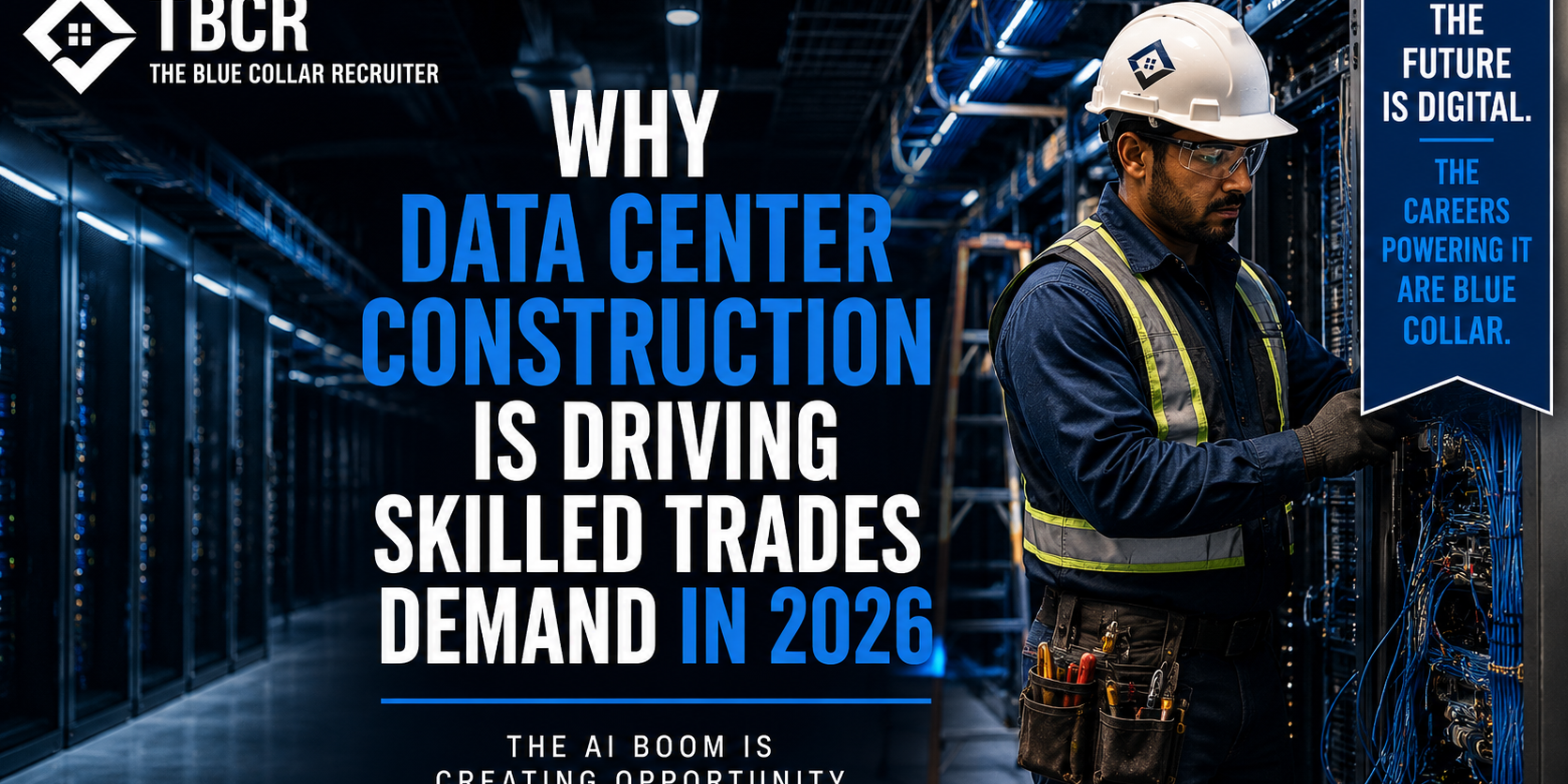
Why Data Center Construction Is Driving Skilled Trades Demand in 2026
Related Reading: Construction Labor Shortage 2026 | 10 Trades with Worst Worker Shortages
Why data center construction is turbocharging Indiana’s skilled trades demand
Indiana has been solidifying its reputation as a hub for data center development. The growth isn’t just about more buildings; it’s about the specific trades those projects require, electrical, mechanical, HVAC, and specialized IT infrastructure technicians. In our experience working with Indiana employers, data center timelines compress the hiring window, raising the value of a workforce that can install, test, and commission critical systems with precision.
Consider a hypothetical scenario: a mid-sized data center developer starts a 20-megawatt build in central Indiana. The project requires quick mobilization of licensed electricians, control technicians, and crane operators who understand clean-room practices and electrical safety standards. The speed of procurement, onboarding, and ramp-up for these roles directly influences the project’s ability to meet commissioning milestones. This illustrative case demonstrates a broader pattern we see across Indiana, data center projects are not just about square footage; they’re about the reliability and readiness of the skilled trades pipeline.
Key trades-enabled by data center growth in 2026
Below are the primary trades you’ll see in higher demand as Indiana continues to attract data center investments. Each one plays a crucial role in staying on schedule and within budget.
-
Electrical technicians and licensed electricians: The backbone of data center builds, from power distribution to installation of high-efficiency equipment and emergency power systems.
-
Mechanical technicians and HVAC specialists: Critical for climate control, air handling units, and filtration systems that protect sensitive IT gear.
-
Civil and structural trades: Foundational work including concrete, steel erection, and cable tray routing that supports dense rack layouts.
-
IT infrastructure technicians and cabling specialists: High-density fiber and copper cabling, structured pathways, and network year-round reliability.
-
Crane operators and rigging crews: Lifting and installing heavy transformers, generators, and modular data hall components.
Two real-world scenarios illustrating the demand shift
Scenario A: The central Indiana campus build
In a purely illustrative scenario, imagine a40-acre data center campus on the near-west side of Indianapolis. The project timeline calls for simultaneous module installations, requiring a synchronized crew of electricians, rigging specialists, and HVAC technicians who can work within strict clean-room protocols. The general contractor relies on a steady influx of skilled trades people who understand how to sequence electrical and mechanical tasks with minimal downtime. When the project hit a temporary staffing gap, commissioning slipped by a week, threatening the entire critical-path schedule. By pre-qualifying a pool of reliable Indy-area trades people and reserving them for the most time-sensitive windows, the team regained control of the schedule and kept milestones intact.
Scenario B: The multi-site colocation expansion
Another illustrative example involves a developer rolling out two adjacent data centers with shared support systems. Each site requires a core team of electrical and IT cabling specialists who can align with standardized processes across both locations. Hiring delays at one site created coordination challenges for the other, underscoring the need for a scalable, standardized intake and onboarding process. A structured approach, clear skill matrices, pre-built onboarding checklists, and a shared pool of pre-vetted trades, allowed the teams to ramp quickly, avoid rework, and keep both sites on track.
E-E-A-T: a practical, credibility-building lens
Illustrative scenario: imagine a staffing partner we’ll call Ridgeline Talent, a hypothetical firm with a focused Indiana practice placing skilled labor for data center builds. They’ve built a repeatable intake framework that maps project requirements to specific trade qualifications, certifications, and on-site readiness. In our experience, staffing teams that treat every job order as a unique entry point and instead use reusable intake templates consistently perform better in fast-moving data center projects. This approach helps ensure you’re aligning the right skill sets with the right milestones, reducing delays caused by misfit placements.
Practical strategies to meet the 2026 Indiana data center demand
Here are concrete steps you can take now to improve your access to qualified trades for Indiana data center construction in 2026.
-
Develop a standardized trade intake framework. Create a reusable template that captures certifications, clean-room or safety requirements, location, preferred schedules, and onboarding steps. This helps reduce time-to-fill and aligns expectations across project teams.
-
Build a ready-to-deploy labor pool. Partner with a staffing provider to maintain a vetted roster of electricians, HVAC technicians, and IT cabling specialists who meet Indiana-specific licensing and safety standards. A ready pool minimizes startup delays when projects accelerate.
-
Implement milestone-driven onboarding. Tie onboarding activities to project milestones (e.g., pre-commissioning, module installation windows) so trades are active exactly when needed, not idling in between tasks.
-
Invest in safety and milestone training. Regular quick-hitting trainings on electrical safety, clean-room protocols, and data-center-specific wiring practices keep teams compliant and productive on site.
-
Leverage a local-first approach. Prioritize Indiana-based crews with proven track records on regional permits, weather considerations, and utility coordination to reduce travel time and logistics risk.
Two actionable templates you can use today
Template 1: Trade Intake Checklist (use for every new data center project)
-
Project name and site location
-
Required trade(s) and seniority level
-
Licenses, certifications, and safety training
-
On-site hours and shift patterns
-
Clean-room or other site-specific requirements
-
Contact point and escalation path
-
Pre-qualification status and onboarding steps
Template 2: Onboarding Milestone Schedule (tie to project milestones)
-
Week 1: Pre-brief, safety overview, and site-specific protocols
-
Week 2: Credential verification and tool familiarization
-
Week 3: Start of installation windows aligned to critical path tasks
-
Week 4: Commissioning readiness review and punch-list kickoff
Common challenges and how to overcome them
Challenge: Difficulty finding electricians with clean-room experience and data center-specific cabling skills.
Solution: Build a targeted sourcing plan with local trade schools, apprenticeship programs, and seasoned contractors who already serve Indiana data center projects. Pair them with a structured onboarding plan to accelerate readiness.
Challenge: Scheduling conflicts when multiple sites run in parallel.
Solution: Use a centralized staffing calendar and milestone-based onboarding to synchronize crews across sites, reducing downtime and improving predictability.
Challenge: Safety compliance in a high-stakes environment.
Solution: Implement concise daily safety huddles, job-specific briefings, and on-site audits. Standardize PPE and equipment checks to minimize incidents and keep projects on track.
Finding the right trades for your data center project
If you’re assessing how to stack your workforce for a data center build, exploring current opportunities and skilled trades paths can help you align with Indiana’s growing demand. For those actively seeking roles in this space, see our current opportunities and skilled trade careers to understand the kinds of positions that commonly appear on Indiana data center projects. Our Current Opportunities – Skilled Trade Careers
For teams evaluating long-term staffing strategies around data center construction in Indiana, this guide aligns with our practice of building repeatable, scalable processes for on-site talent management. To see how we categorize and place skilled trades in these projects, review our approach and the types of roles we regularly staff: Why Data Center Construction Is Driving Skilled Trades Demand in Indiana in 2026
Conclusion: what to do next
After reading this post, you’ll be able to map Indiana data center milestones to a concrete trades staffing plan, create reusable intake templates, and launch a ready-to-deploy labor pool that reduces onboarding time.
Ready to take the next step? Start by auditing your current onboarding process and identifying where a milestone-driven approach could shave days or weeks off ramp-up. If you’d like targeted help building a scalable, Indiana-focused skilled trades pipeline for your data center projects, we can tailor a plan that matches your project schedule and labor needs. Begin with an intake review and experiment with a milestone-based onboarding calendar to prove value quickly.
See our broader national analysis: why data center construction is driving skilled trades demand across the country.
Related Reading
Share this post
More Resources
You are one click away from launching a rewarding trade career.