
Your tradecraft expert, providing you every opportunity to learn and grow.

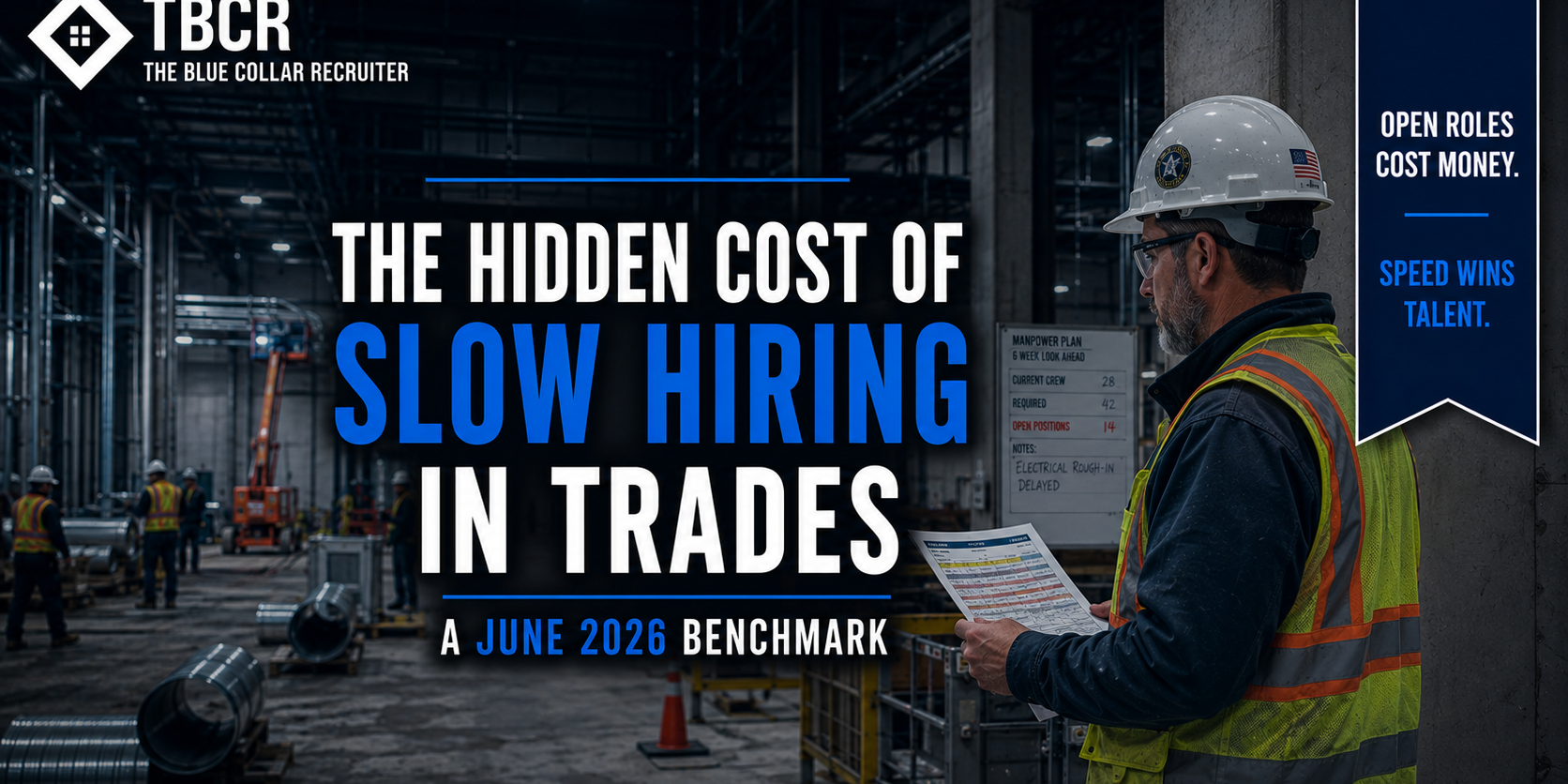
The Hidden Cost of Slow Hiring in Trades: A June 2026 Benchmark
Blue collar worker training inline guide

If you’re managing a skilled trades operation, whether HVAC, electrical, plumbing, or construction, you’ve probably heard the phrase “we can’t find people.” What you hear less often is the price tag attached to every single day that seat stays empty. Most trades companies obsess over hiring costs: recruiter fees, job board subscriptions, onboarding time. Those numbers sit on a spreadsheet and feel concrete. The real financial wound, the revenue you lose, the crew strain you create, the customers you disappoint, stays invisible until it compounds into a crisis.

This benchmark unpacks what an unfilled trades role actually costs your operation per day, with a practical calculator template you can apply to your own headcount gaps before peak summer season hits. In our analysis of dozens of trades operations, the companies that hire fast and fill seats before June consistently capture 20, 40% more seasonal revenue than those still recruiting through July and August.

If you’re currently relying on traditional job boards alone, you may want to explore a more proactive approach like our Blue Collar Hiring System, which combines premium job distribution, Human + AI-powered candidate sourcing, and automated engagement to help companies fill positions faster.

The Vacancy Tax Nobody Talks About in Skilled Trades Hiring

This pattern plays out with remarkable consistency across the industry. Practitioners working dispatch and operations report the same sequence: openings linger through spring, peak season arrives while seats remain unfilled, margins collapse despite strong demand. To illustrate, consider TruTemp Climate Services, a 12-technician HVAC company operating across three service areas in the Southeast. It’s late May, and two technician roles sit open. The hiring team posted ads three weeks ago, screened a handful of applicants, and conducted one interview that didn’t convert. Customers are already calling with early-season requests. Dispatch is juggling available crews across more jobs than they can realistically handle. The owner wonders why profit margins look soft this quarter, even though the call volume is strong.

The real story: those two open seats have been silently draining the company since day one of vacancy. Not because of hiring fees. Because every unfilled position represents lost capacity, degraded crew efficiency, and eroding customer retention. The operational math compounds faster than most owners realize.

This post reframes the conversation away from cost-per-hire, the visible, one-time expense, toward the hidden daily tax of running lean. We’ll walk through how that math stacks up, provide industry-specific scenarios, and give you a template to calculate your own true cost of vacancy for summer 2026.

What an Open Trades Position Actually Costs Per Day: The Operational Math

Lost billable revenue is the starting point. Each unfilled technician, electrician, or plumber seat represents a ceiling on how many jobs your team can complete. When a journeyman electrician is on the clock, their labor generates billable hours. When the seat is empty, that revenue doesn’t exist, it isn’t reduced; it vanishes. If a typical technician produces $800 in billable work per day, that’s $800 gone every single day the role sits unfilled.

But the pain radiates outward from there. Your remaining crews absorb the overflow. Technicians take longer routes to cover more service calls than they were scheduled for. They handle work outside their core specialty because dispatch has no other option. Quality suffers. Installation accuracy and safety checks slip when people are rushed. Per-technician productivity drops measurably, even though the workload is higher. Burnout accelerates faster than you’d expect, often pushing your best people to explore other opportunities.

Scheduling collapse adds another hidden drag. Your dispatch and project management team spend disproportionate energy reshuffling routes, managing customer delays, and fielding complaints. Hours that should go toward coordination, upsell opportunities, and revenue-generating work instead get consumed by triage. It’s invisible work, but it compounds.

Industry-Specific Damage: HVAC, Electrical, and Plumbing During Peak Season

Summer peak season amplifies every cost of vacancy. Demand spikes hard and predictably, and slow hiring means you enter that window understaffed.

HVAC and cooling season. June through August is when your phone rings constantly. Air conditioning breakdowns, new installations, maintenance contracts, the work is there. An open technician role during this window isn’t just lost revenue; it’s lost market share. Customers you can’t serve this month don’t follow up in September; they call the competitor who answered. If your crew is maxed out and you’re turning work away, you’re also training customers that your company isn’t reliable. One missed summer season can dent your reputation through the next winter.

Electrical and commercial builds. Many commercial and construction projects have tight summer windows. If your electrical team is short a journeyman or licensed electrician, job timelines slip. Penalty clauses kick in. General contractors who depend on you move to more reliable subs. Next year’s bid list might not include you.

Plumbing and emergency response. A short plumbing crew means longer response times to emergency calls. Customers tolerate a reasonable wait during normal hours, but plumbing emergencies don’t respect business hours. When your team is overwhelmed and response time balloons, customers feel abandoned. They leave bad reviews. They call other plumbers and discover competitors have faster service. Customer lifetime value drops faster in service trades than in almost any other sector.

All three sectors face the same reality: slow hiring means entering peak season already behind. Every day of vacancy before June compounds into lost jobs, missed contracts, and eroded customer trust.

Customer Relationship Damage and Contract Risk

Slow response times and rescheduled appointments create friction that feels small in the moment but accumulates into customer churn. Residential customers forgive one delayed appointment. They become frustrated by a second. By the third, they’ve called someone else. Commercial clients and general contractors have even less patience, they’re managing projects and budgets. Unreliable subcontractors get replaced, and you don’t always get advance notice.

There’s also contract risk that doesn’t show up in spreadsheets until it’s too late. If you’ve committed crew hours to a project and can’t deliver on schedule because you’re understaffed, penalties apply. Repeat lateness or failure to staff positions can be grounds for contract termination with major commercial clients. One lost contract with a reliable commercial partner can represent months of lost revenue, far more than the daily operational cost of a single vacancy.

Safety Exposure When Crews Run Lean

Fatigued workers make mistakes. When your team is regularly pulling overtime to cover open positions, exhaustion compounds. Fatigue reduces attention to detail, slows reaction time, and increases the risk of on-the-job accidents. Electrical work, fall hazards in construction, and HVAC work at heights all carry inherent risk that amplifies under fatigue. A safety incident doesn’t just cause immediate harm, it triggers OSHA investigations, workers’ comp claims, potential liability, and reputational damage that can take years to recover from. The cost of even one preventable accident far exceeds the cost of hiring faster.

Slow hiring isn’t just an operational inefficiency; it’s a safety multiplier when crews are consistently below full capacity.

Building Your Own True Cost of Vacancy Calculator

The math only feels abstract until you put your own numbers into it. Here’s how to calculate the real daily cost of an open trades position in your business.

Step 1: Establish Daily Billable Revenue Per Role

What does a fully productive technician, electrician, or crew lead generate in billable revenue per day? Don’t overthink this, look at your average daily job revenue and divide by the number of people generating it. If your team bills $6,000 on a typical day and three techs are in the field, that’s roughly $2,000 per tech per day. This is your baseline lost revenue per day of vacancy.

Step 2: Account for Crew Drag and Productivity Loss

When one seat is empty, your remaining crew doesn’t automatically pick up 100% of that lost revenue. They pick up maybe 60, 70% because they’re stretched, working outside their specialty, and moving slower due to overcapacity. Multiply your per-person daily billable revenue by 0.65 to estimate net lost productivity per empty seat. So if one tech generates $2,000 daily, you’re losing roughly $1,300 in actual completed work when that seat is vacant.

Step 3: Add Operational Friction Costs

Dispatch reshuffling, customer service rework, rescheduled appointments, and delayed communications cost time, and time is money. Estimate conservatively: add 5, 10% to your productivity loss figure to account for the administrative drag of managing lean operations. If you’re already at $1,300 in lost revenue, add another $65, 130 for operational friction per empty seat per day.

Step 4: Calculate Monthly and Seasonal Impact

Multiply your per-day figure by 21 working days (accounting for weekends) to get a monthly cost. Now multiply that by the number of open seats. Here’s a concrete example: if you have two open technician positions, each generating roughly $1,400 in lost daily output (including friction), that’s $2,800 per day in total lost capacity. Over 21 working days, that’s $58,800 per month. Over a three-month summer season, that’s $176,400 in lost revenue from those two seats alone.

Now subtract what you’d actually spend to hire faster, expedited recruiting, multiple job board placements, paid advertising, and you’ll likely find that the total investment in accelerating hiring is a tiny fraction of the cost of staying short-staffed.

A Note on the Calculator’s Limits

This template provides a useful order-of-magnitude estimate, but it assumes your team has available work to fill those hours, which is usually true during peak season but may not hold if demand is truly soft. Additionally, the friction costs are qualitative and vary by business structure. Use this as a directional tool, not gospel, but you’ll likely find the real cost is higher than you assumed, not lower.

Why Summer Hiring Requires a Different Approach

Most trades companies hire reactively. Someone quits in May, posting goes live in June, interviews happen in July, and the new hire starts in August. By then, peak season is half over and your best customers have already found alternatives.

Summer hiring demands compression. You need a system that moves from job posting to qualified candidate to interview offer in days, not weeks. That’s the only way to enter peak season staffed, not scrambling.

The tools that help this compression, multi-platform job distribution, AI-powered candidate screening, instant automated engagement that keeps applicants in the funnel instead of letting them go dark, and centralized workflow visibility, aren’t luxuries anymore. They’re prerequisites if you’re serious about capturing summer demand without sacrificing crew safety or customer retention.

What to Do Right Now Before Summer Peaks

Start by calculating your own true cost of vacancy using the template above. Plug in your numbers. The result will likely shock you into action.

Next, audit your current hiring process. How long does it take from job posting to first interview? From first interview to offer? If the answer is more than two weeks for either stage, you have a speed problem. Document the bottlenecks, whether it’s slow candidate screening, poor application filtering, or delayed communication.

Then, look at your job posting strategy. Are you posting to one board, or are you reaching multiple platforms simultaneously? A single posting on Indeed will generate applications, but they’ll arrive slower and your qualified candidate pool will be smaller. Firms that distribute jobs across multiple platforms and maintain active sourcing from resume databases instead of waiting for applications to come in compress hiring timelines dramatically.

Finally, establish a commitment to response time. Every candidate application should receive acknowledgment within 24 hours. Qualified candidates should be contacted for interviews within 48 hours. Most trades companies miss this window, and candidates move on. Even modest improvement in responsiveness, especially with AI-powered immediate engagement during business hours and after-hours, will improve your conversion rate without requiring more staff.

The cost of slow hiring isn’t just on paper. It’s real revenue walking out the door every day you’re understaffed heading into peak season. The time to act isn’t June. It’s now. Schedule a consultation today to see how much revenue your business could recover by filling open positions faster.

Share this post

You are one click away from launching a rewarding trade career.